Showing posts with label historical fiction. Show all posts

Wednesday, January 7, 2015

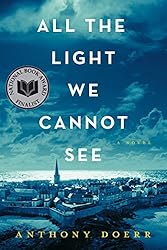
All the Light We Cannot See, first read of the new year

My first official read of the new year was All the Light We Cannot See by Anthony Doerr.  And before I was half-way through the book, I was already recommending it to others, hoping they would read it as soon as possible, so we could have a book discussion.  And really this book is ripe for discussion.

Anthony Doerr's book made it to the top of numerous top ten of 2014 books and that is how I discovered it.  My trusty EW reviewer told me that the book was about a boy and a girl and was the most hopeful book they had read in a while.  At least that's what I remember from the review.  And although I am not normally a fan of historical fiction, I thought I would give it a go.

I, like the EW reviewer, do not want to give away too much of the book.  (I hate spoilers and you should, too!) So, I will just say that it follows the lives of a number of people including a girl and a boy in the years leading up to and during the Second World War.  And even as I sit writing this review, I am struck by one major theme: truth.

In the years leading up to the Second World War truth (the this-is-the-real-deal, unadulterated truth) was scarce.  Propaganda was rampant.  But what was worse than that is many people wanting to create their own truth because what they saw around them just couldn't be so.  The horrors of the Third Reich's rise presented people with the opportunity to face the reality of what was happening or create their own excuses or escapes to remove themselves from the harsh truth.  Often the excuse was self-preservation - knowing that if you had to face reality, it would destroy you or ones you loved, or both.

This is what I see as a major theme of the book and of my favorite movie of all time, Life is Beautiful.  The reader/viewer is forced to place herself in the shoes of the characters and ask herself, "What would I do in that situation? Would I lie to those I love?  Would I lie to myself?  Could I accept the truth of the situation, or would I choose to escape/ignore?"

In All the Light We Cannot See many of the characters choose to believe stories they are told, to believe propaganda, to see what they want to see, and even to lie to one another in hopes of providing comfort.  But there are a brave few in the book: the ones who see the truth and refuse to cover it up with myths and denials.  These are the characters that I connected with in the book.

There are many more themes to explore from the book.  As I said, it would make a great book for group discussion.  Ultimately, I very much enjoyed the simple (yet often profound) prose and the structure of the book (a jumbled timeline converging to a single day).  I did not check to see how many pages the book was before reading it on my e-reader.  I felt this would be a short book and so I savored each word for the first 100 pages or so.  But then I checked and found it was over 500 pages and upped my reading pace decidedly.  I feel like the the denouement could have almost been omitted and found I would have liked for the story to end differently, but the Second World War didn't provide everyone with a perfect ending, either.

Have you read it?  Let's talk.

-L

Rating: 5 out of 7
This book fulfills the "Book by an Author You Haven't Read" requirement in my challenge for the year.

Wednesday, August 24, 2011

The Daughter's Walk

A walk to remember?  Hmm...oh wait, that is another book altogether (one I haven't read - missed out on the Sparks phenomenon).  No, this is a whole other genre: historical fiction. 

It may surprise many people who know although I love history (it was my major in college),  I do not like historical fiction.  I would rather spend my time reading a biography or book on events in history than reading someone's imaginings of a certain historical period or person.  Oh, and it may surprise others that although I am a Christian (did I mention my major in college was actually church history?), I don't like Christian fiction - again the same thing applies.  So, when I signed up to get The Daughter's Walk as an ARC, I really don't know what I was thinking. 


The Daughter's Walk is the story (based on actual people) of a mother-daughter team who decide to walk across the United States, sponsored by a group of investors to promote dresses (that ladies can walk in) and save the family farm at the turn of the 20th century (an actual time).  I think this is where actual history and fictional history part ways and the author takes over in the storytelling department.  The story becomes a basic prodigal story without the squandering of inherited fortune and without the loving father taking back the wayward daughter. 

So, what is missing?  Um...my interest.  I did not really enjoy this book.  I got through it but I found it tedious and mundane.  Each of the story elements seemed to be attempts to be historical fiction.  Yes, I do know that should be an accomplishment, given it's intended genre.  But what I mean is the author seemed to be working to make it historical in nature.  She has entire paragraphs where she attempts to show the passing of time by almost listing the things she found out about the period when she was conducting research.  It is not woven into the story, it is an obvious "this is the time we are talking about" device. 

Which brings me to the question: What would it take for historical fiction to capture my interest? 

I think it should be the type of work where the reader feels like they are actually reading a work of history.  Where the author has done the research so well and so intertwined it with the story that it could feel as though it was written during the historical period or by the best historian EVER!  Have you ever watched the Ken Burns series for PBS on the American civil war?  The historians in there never met, nor walked this earth during the civil war (I know because I have done the math and they would have to be over 150 years old); yet they speak about the men and women of the day as though they grew up with them - they breathe life into the dead.  That doesn't mean they are right all the time.  There is no way they could know the emotional lives of these people; but they use inference and a little bit of imagination to bring the viewer right on the scene, experiencing the war right along with them. 

So, until authors can approach their subjects this way (or someone can recommend an author who does), I'll take my actual history the way it was intended to be digested - in fascinating non-fiction. 

Which brings me to the question: What would make you enjoy Christian fiction? 

This I have less of a grip on.  As it goes right now, I am on a case-by-case basis for Christian fiction.  I absolutely loved The Great Divorce and Redeeming Love.  But other Christian fiction has not captured my heart the way these two did.  So, I am not scanning the shelves of the Christian fiction section of the local Barnes and Noble very often; but I have not closed my mind on the genre the way I have for historical fiction.  All that to say, I will take your recommendations for Christian fiction, just don't make it Christian historical fiction - I don't think I could take it.

Rating: 2.5 out of 5

-L

NOTE: I received a copy of this book in exchange for an honest review from Waterbrook Multnomah through their Blogging for Books program.  If you enjoyed or hated this review, you have recourse: rate my review.  You just may get a free copy of this book.